Formic acid, a simple carboxylic acid with the chemical formula HCOOH, is extensively used across numerous industries due to its versatile chemical properties. As an important industrial chemical, formic acid is widely applied in leather processing, textile dyeing, rubber manufacturing, animal feed preservation, chemical synthesis, and pharmaceutical production.
With growing global demand and increasing attention to sustainable chemical manufacturing, the production technology of formic acid has evolved significantly over the years. This article explores the major industrial production methods of formic acid, compares their advantages and limitations, and examines future trends in environmentally friendly manufacturing technologies.
The Basics of Formic Acid
Formic acid is naturally found in ants, bees, and certain plants. Industrially, it is valued for its strong acidity, antibacterial performance, reducing capability, and preservative properties.
Today, formic acid is considered an essential raw material in many industrial sectors because it offers:
As industrial applications continue to expand, manufacturers are focusing on improving production efficiency, reducing environmental impact, and lowering overall manufacturing costs.
Global Mainstream Production Route of Formic Acid
Currently, the methyl formate hydrolysis route derived from methanol carbonylation is regarded as the dominant industrial process for formic acid production worldwide. This technology accounts for most global installed production capacity due to its high efficiency, stable raw material supply, and suitability for continuous large-scale manufacturing.
Compared with older production methods, modern carbonylation technology provides:
Higher raw material conversion efficiency
Lower production cost per ton
Easier methanol recycling
Better scalability for industrial plants
More stable product quality
Traditional oxidation-based routes and oxalic acid decomposition methods are now mainly limited to niche or small-scale applications.
Methanol Carbonylation Process
One of the most widely used industrial methods for producing formic acid is methanol carbonylation. In this process, methanol reacts with carbon monoxide under pressure in the presence of catalysts to form methyl formate, which is then hydrolyzed into formic acid.
Process Steps
1. Methanol Preparation
Methanol feedstock is purified and dried to remove water and impurities that may affect catalyst performance.
2. Carbonylation Reaction
Methanol reacts with carbon monoxide under elevated pressure and temperature conditions to produce methyl formate. Catalysts such as sodium methoxide or metal complex catalysts are commonly used to improve reaction efficiency and selectivity.
3. Hydrolysis of Methyl Formate
Methyl formate is hydrolyzed with water to generate formic acid and methanol. The recovered methanol can be recycled back into the production system.
4. Purification and Distillation
The crude formic acid solution undergoes distillation and purification to achieve the required industrial or commercial concentration.
Advantages of Methanol Carbonylation
High yield of formic acid
Continuous large-scale production capability
Efficient methanol recycling
Mature industrial technology
Stable product purity
Lower overall production costs
Typical Industrial Operating Conditions
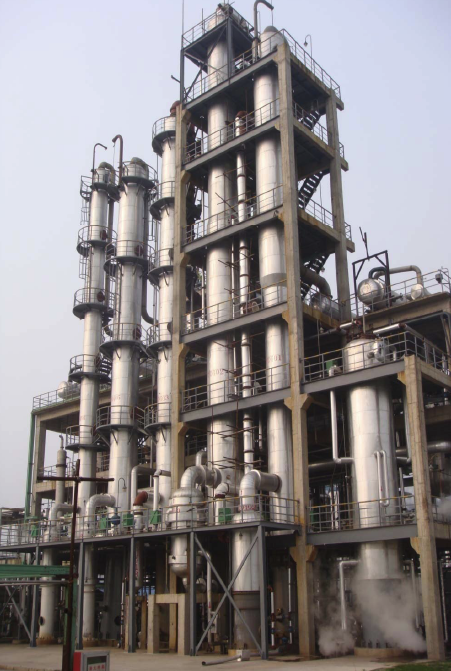
Industrial methanol carbonylation systems are generally operated under controlled high-pressure and medium-temperature conditions to maximize methyl formate conversion efficiency and maintain stable continuous production.
Large-scale chemical plants often adopt automated continuous processing systems because they improve:
Raw material utilization
Energy efficiency
Product consistency
Production stability
Operational safety
Sodium Formate Process
The sodium formate process is another traditional method used in formic acid manufacturing. This process involves the reaction of carbon monoxide with sodium hydroxide to produce sodium formate, followed by acidification.
Process Steps
1. Carbon Monoxide Absorption
Carbon monoxide reacts with sodium hydroxide solution to form sodium formate.
2. Acidification Reaction
Sodium formate is treated with sulfuric acid to generate formic acid and sodium sulfate byproduct.
3. Product Separation
The resulting formic acid solution is separated, purified, and concentrated.
Advantages
Readily available raw materials
Relatively simple process
High-purity formic acid production
Suitable for industrial-scale manufacturing
Limitations
Produces sodium sulfate waste
Higher downstream treatment requirements
Lower environmental efficiency compared with newer technologies
Oxalic Acid Decomposition Method
Formic acid can also be produced through the thermal decomposition of oxalic acid. Although this method is less common in large industrial facilities today, it remains suitable for certain laboratory and specialty chemical applications.
Process Steps
1. Oxalic Acid Heating
Oxalic acid is heated in the presence of a strong acid catalyst.
2. Thermal Decomposition
The decomposition reaction produces formic acid and carbon dioxide.
3. Product Recovery
The generated formic acid is separated and purified.
Advantages
Relatively simple production process
Lower pressure requirements
Suitable for smaller-scale production
Limitations
Electrochemical Reduction
In recent years, the electrochemical reduction of carbon dioxide has emerged as a promising method for This process uses electricity to convert carbon dioxide directly into formic acid.
Process Steps:
1. Electrochemical Cell Setup: An electrochemical cell with appropriate electrodes and electrolyte is prepared.
2. CO2 Reduction: Carbon dioxide is reduced at the cathode to formic acid.
Advantages:
- Environmentally friendly, utilizing CO2 as a feedstock.
- Can be integrated with renewable energy sources.
- Potential for high efficiency and selectivity.
Electrochemical Reduction of CO₂
In recent years, electrochemical reduction technology has emerged as one of the most promising sustainable production routes for formic acid. This method directly converts carbon dioxide into formic acid using electricity and catalysts.
Process Steps
1. Electrochemical Cell Setup
An electrochemical system equipped with cathodes, anodes, catalysts, and electrolyte solutions is prepared.
2. Carbon Dioxide Reduction
Carbon dioxide is reduced at the cathode surface to generate formic acid.
3. Product Collection and Purification
The generated formic acid is separated and purified for industrial applications.
Advantages
Utilizes carbon dioxide as feedstock
Supports carbon reduction initiatives
Can integrate with renewable energy systems
Potentially lower environmental impact
Current Challenges
Although electrochemical CO₂ reduction technology has attracted significant research interest, several challenges still limit large-scale commercialization:
High equipment investment cost
Catalyst stability issues
Energy consumption optimization
Industrial scalability limitations
Nevertheless, many researchers consider CO₂-based formic acid synthesis one of the most promising future directions for green chemical manufacturing.
Comparison of Formic Acid Production Technologies
| Production Method | Main Raw Materials | Industrial Maturity | Main Advantages | Main Limitations |
|---|
| Methanol Carbonylation | Methanol + CO | Very High | High yield, scalable, cost-efficient | Requires high-pressure systems |
| Sodium Formate Route | CO + NaOH | High | Mature and cost-effective | Produces sodium sulfate waste |
| Oxalic Acid Decomposition | Oxalic Acid | Medium | Simple process | Lower scalability |
| Electrochemical CO₂ Reduction | CO₂ + Electricity | Emerging | Sustainable and low-carbon | High investment cost |
Why Methanol Carbonylation Became the Dominant Technology
Methanol carbonylation became the mainstream industrial route because it offers significant economic and operational advantages for modern chemical plants.
Compared with older technologies, this process provides:
High raw material conversion efficiency
Continuous production capability
Lower manufacturing costs
Easier feedstock recycling
Mature catalyst systems
Stable industrial operation
Consistent product purity
As global demand for formic acid continues to increase, the methanol carbonylation route remains the preferred choice for large-scale manufacturers.
Sustainable Trends in Formic Acid Manufacturing
As global industries move toward carbon reduction and sustainable chemistry, chemical manufacturers are increasingly exploring greener production technologies for formic acid.
Electrochemical CO₂ reduction has become an important research direction because it converts captured carbon dioxide directly into formic acid using electricity. When combined with renewable energy sources such as solar or wind power, this technology may help reduce greenhouse gas emissions and dependence on fossil-based feedstocks.
In addition, manufacturers are focusing on:
Energy-efficient reactor systems
Waste reduction technologies
Improved catalyst recycling
Lower-emission production systems
Integrated carbon utilization processes
These developments are expected to play an important role in the future evolution of the global formic acid industry.
Growing Market Demand for Formic Acid
Global demand for formic acid continues to rise due to expanding applications across multiple industries.
Key demand drivers include:
Animal feed preservatives
Leather processing
Textile dyeing
Rubber production
Chemical intermediates
Pharmaceutical manufacturing
Cleaning and deicing applications
In recent years, formic acid has also attracted attention as a potential hydrogen carrier and energy storage material because it can release hydrogen under controlled conditions. This emerging application is driving further research into cleaner and more sustainable production technologies.
Applications of Formic Acid
Leather and Textile Industry
Formic acid is widely used in leather tanning and textile dyeing because it helps regulate pH levels and improve processing efficiency.
Agriculture and Animal Feed
In agriculture, formic acid serves as a preservative and antibacterial additive for livestock feed, helping improve feed stability and animal health.
Chemical Synthesis
Formic acid acts as a reducing agent, catalyst, and intermediate in the production of numerous industrial chemicals.
Food Industry
The food industry uses formic acid as a preservative and antibacterial agent to improve food safety and shelf life.
Pharmaceutical and Rubber Industries
Formic acid is also applied in pharmaceutical synthesis, rubber coagulation, and specialty chemical manufacturing.
FAQ About Formic Acid Production
What is the most common method for producing formic acid?
The methanol carbonylation process is currently the most widely used industrial method for producing formic acid worldwide.
What raw materials are used in formic acid production?
Common raw materials include methanol, carbon monoxide, sodium hydroxide, oxalic acid, and carbon dioxide.
Is formic acid production environmentally friendly?
Traditional production technologies rely mainly on fossil-based feedstocks, but emerging CO₂ electrochemical reduction technologies offer more sustainable alternatives.
Can formic acid be produced from carbon dioxide?
Yes. Electrochemical reduction technology can convert carbon dioxide into formic acid using electricity and catalysts. This technology is considered a promising low-carbon production route for the future.
Conclusion
The production technology of formic acid has evolved from traditional chemical synthesis routes to more advanced and sustainable manufacturing processes. Among the available technologies, methanol carbonylation remains the dominant industrial production method due to its high efficiency, scalability, and economic advantages.
At the same time, growing environmental awareness and carbon reduction goals are accelerating research into greener technologies such as electrochemical CO₂ reduction.
As a professional supplier of high-quality formic acid products, SL Tec is committed to providing reliable chemical solutions that meet the evolving demands of global industries. For more information about our products, production capabilities, or bulk supply services, please contact our team.